There are three ways to build a small business website: do it yourself on a website builder, hire a freelancer, or hire an agency or studio. Each can work. The right one depends on your budget, how much time you have, and how much the website needs to do for your business.
A plumber who mostly gets work from referrals needs something different to a clinic taking online bookings or a shop selling online. This page compares the three routes honestly for an Australian owner, with real costs and time, then walks through the steps every website needs no matter who builds it: the goal, the .com.au domain, pages, copy, photos, Google Business Profile and tracking. It finishes with a short checklist to help you decide.
Key Takeaways
- DIY builders cost the least upfront, often a few hundred dollars a year, but you supply all the time, words and photos.
- Freelancers cost less than agencies for similar work, but coverage and support depend on one person.
- An agency or studio costs more and suits businesses that need the website to bring in leads or sales.
- Every route needs the same groundwork: a clear goal, a .com.au registered to your ABN, good copy, real photos and tracking.
- Choose based on what a new customer is worth to you, not only the build price.
What are the three ways to build a small business website?
The three routes differ mostly in who does the work and who carries the risk. This table gives the short version.
| DIY builder | Freelancer | Agency or studio | |
|---|---|---|---|
| Upfront cost | Plan fees only | Lower project fee | Higher project fee |
| Your time | High | Medium | Low to medium |
| Copy and photos | You | Sometimes included | Usually included or offered |
| Strategy and tracking | You | Varies | Usually included |
| Ongoing support | Builder help centre | Depends on the person | Usually a care plan or retainer |
| Best for | Testing an idea, simple sites | Clear, smaller projects | Sites that need to win work |
For price context, one Australian agency’s published guide lists DIY at $500 to $1,500 a year and professionally built small business sites at $3,000 to $10,000. Our website cost guide has the full ranges and a three-year cost comparison.
Should you build your website yourself?
Build it yourself if your budget is tight, your needs are simple and you have time to learn a tool. DIY is a sensible way to get online quickly and test whether a business idea has legs.
What DIY costs
You pay the builder’s plan. Squarespace’s pricing page lists Basic at A$18.70 a month and Core at A$30.80 a month on annual billing, including estimated GST, as at October 2026. Add a domain and email. One Australian agency guide puts DIY or template builds at $1,000 to $4,000.
The upside
- Lowest upfront cost
- You control every change
- Hosting, security and updates are handled by the platform
The downside
The real cost is your time. You will plan the pages, write every word, find photos, set up forms and learn the editor. Many owners underestimate the writing in particular. Templates also make it easy to look like everyone else, and you are tied to that platform if you want to move later.
If you are leaning this way, our comparison of Wix vs Squarespace vs WordPress will help you pick a builder.
Should you hire a freelancer?
Hire a freelancer when you have a clear, contained project and you can find someone with work you like. A good freelancer can produce excellent work at a lower price than an agency.
The upside
- Usually cheaper than an agency for similar scope
- You deal directly with the person doing the work
- Flexible on process and timing
The downside
One person rarely covers everything. A great designer may not write copy, set up conversion tracking or handle SEO. If they get sick, busy or move on, support can stop. Make sure you know who will update the site, and what happens if you part ways.
How to check a freelancer
- Look at three or more live sites they built, on your phone.
- Ask past clients whether the site was delivered on time and how support has been.
- Get a written scope listing pages, who writes the copy, and what is excluded.
- Confirm the domain, hosting and website files will be in your name.
Should you hire an agency or studio?
Hire an agency or studio when the website has a big job to do, such as generating enquiries, taking bookings or selling online. You pay more, and in return you get a team that covers strategy, design, copy, development, tracking and ongoing care.
The upside
- Planning before design, so every page has a purpose
- Copy, SEO foundations and tracking are usually part of the job
- A team behind the site, so support does not depend on one person
- Often linked services such as SEO and ads
The downside
It costs more, and some agencies add process you do not need. Bigger agencies may hand your project to junior staff after the sales meeting. Ask who will actually work on your site.
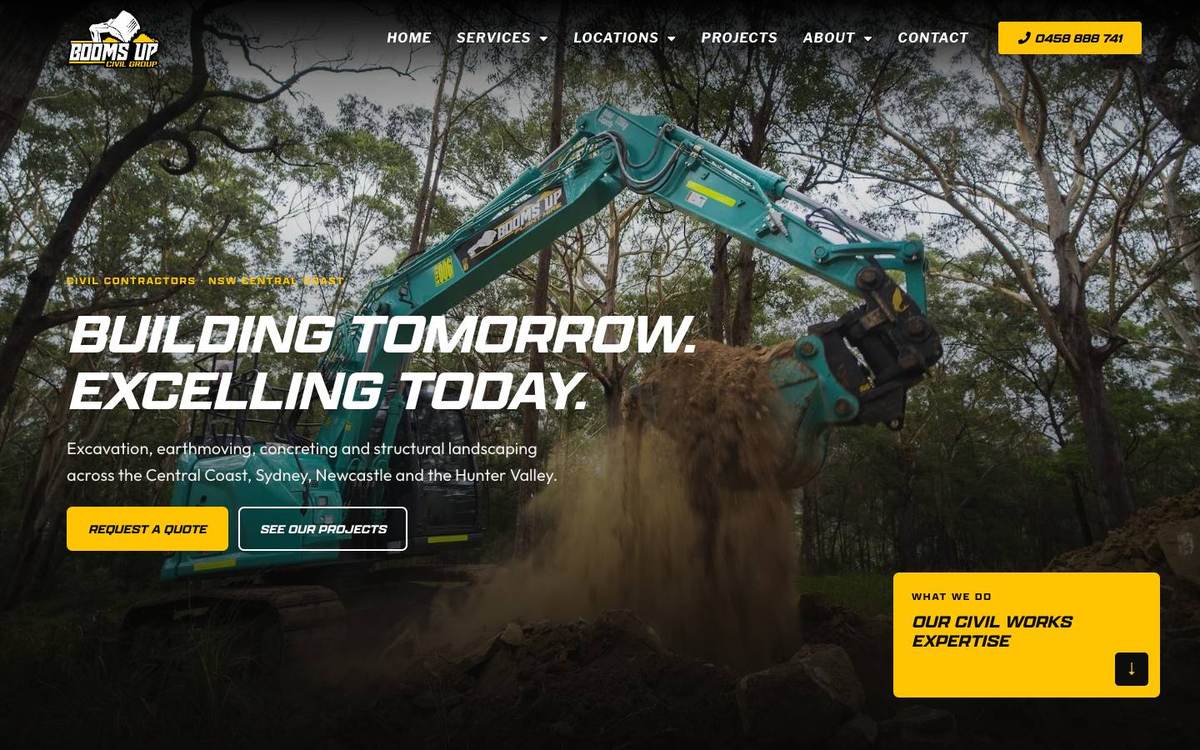
The difference shows up in results when the site is built around a business goal. Booms Up Civil Group had no website before working with us. With a website, SEO and short-term ads, it went from nothing to 350+ conversions in 12 months. Papa V Pizza, a new Central Coast pizza shop, had 2,000+ website users in its first month. In both cases, each page was planned around a job and tracking was in place from launch.
What steps does every small business website need?
Whichever route you choose, the same groundwork decides whether the website works. business.gov.au sets out ten steps for a business website, starting with defining your goals and ending with maintaining and measuring the site. Here is how those steps play out for a small business.
1. Set one clear goal
Decide the main thing the website should get people to do: call, book, buy or send an enquiry. Every page should lead toward it. The same government guide suggests reviewing your business and marketing plans first so the website lines up with them.
2. Register a .com.au domain to your ABN
Most Australian businesses use a .com.au. According to business.gov.au’s domain name guide, to get one you need to be a commercial entity with an ABN or ACN. All .au names also require an Australian Presence, most commonly shown by a valid ABN or ACN, or Australian citizenship or permanent residency. auDA says a shorter “.au direct” name, like yourbusiness.au, is open to anyone with a connection to Australia.
Two things trip owners up. First, a domain does not give you any legal protection for the name, so register your business name and consider a trade mark. Second, under auDA’s renewal rules you must keep meeting the eligibility rules for the whole licence, which runs one to five years. Keep the domain in your own account so renewal reminders reach you.
3. Plan your pages
Map the pages before anyone designs anything. business.gov.au lists common pages such as an about page, contact details or form, service descriptions, reviews, FAQs and terms. For most service businesses, a separate page for each main service works better than one long services page, because each page can answer one type of search.
4. Write copy for your customers
Write the words around what your customer needs to know to choose you: what you do, where, for whom, what it costs or how to get a price, and why you. Put the most important information first and use short sentences, as business.gov.au recommends. If writing is not your strength, our website copywriting guide breaks it down.
5. Use real photos
Photos of your team, your work and your premises build trust faster than stock images. A half-day shoot is often the best money you spend on a new site. Tradies can start with good phone photos of finished jobs.
6. Set up your Google Business Profile
A Google Business Profile is the listing that shows your business on Google Maps and in local results. Link it to your website, keep your name, address and phone number the same on both, and ask happy customers for reviews. Our guide on how to get your website on Google covers this step by step, and our Central Coast SEO page shows how local search fits in.
7. Track what matters
Set up tracking before launch so you can count calls, form enquiries, bookings and sales. business.gov.au recommends using analytics to understand visitors and improve the site over time. Without tracking, you cannot tell whether the website is paying for itself.
8. Keep it secure and updated
If your site is self-hosted, such as on WordPress, you need to apply security updates regularly. A builder handles that for you. Either way, use a strong password and two-factor authentication. A website care plan is one way to hand this over.
Which option is right for your business?
Pick the route that matches what the website needs to achieve and what your time is worth. Work through this checklist and count your answers.
DIY is likely enough if:
- You are testing a new idea or have a very small budget
- Most of your work comes from referrals or word of mouth
- You enjoy writing and have time each week to learn and update the site
A freelancer is a good fit if:
- You have a clear scope and can write a good brief
- You have found someone whose live sites you like
- You or someone else can handle copy, tracking and updates
An agency or studio makes sense if:
- The website needs to generate leads, bookings or sales
- You need integrations such as bookings, CRM feeds or an online store
- You plan to run SEO or ads to the site
- You would rather spend your time running the business
A quick test: work out what one new customer is worth over a year, then ask how many extra customers the website would need to win to cover the build. If the answer is two or three, a professional build is usually worth it. If the answer is fifty, start with DIY and upgrade later.
Frequently asked questions
How much does it cost to create a website for my small business?
A small business website costs from a few hundred dollars a year on a DIY builder to several thousand dollars for a professional build. One Australian agency guide lists DIY at $500 to $1,500 a year and professional small business sites at $3,000 to $10,000. Add a .com.au domain, hosting or a plan, and email each year.
Is Google Sites 100% free?
Google Sites costs nothing to build with, and TechRadar’s review calls it “a great free option”, but a business usually pays for extras around it. Using your own domain means buying one, either from a registrar or through a Google Workspace plan, and Google Sites Help says the address must include a subdomain such as “www”. Business email through Google Workspace starts at A$9.90 per user per month on an annual plan, excluding tax.
How do I make a website for my business for free?
You can make a free website with Google Sites or a website builder’s free plan. The trade-offs are the builder’s branding and no custom domain: Wix, for example, needs a paid plan to connect your own domain and remove its branding. A free site is fine for testing an idea. For a business, a .com.au domain registered to your ABN is worth the small yearly cost.
Talk it through before you build
If you are weighing up the routes and want a straight answer on which one fits your business, have a look at how our website design process works, or see examples of websites for tradies. Keener quotes each build to scope, based on the number of pages, whether you need an online store, who writes the content and how complex the design is. Most sites take 6 to 10 weeks from kickoff to launch, and we set out the timeline at kickoff so you know what’s due and when.