No, ChatGPT is not the end of Google My Business. Google Business Profile, as it is now called, still drives most local discovery in Australia, and you should keep looking after it. But on 10 November 2026 OpenAI opened Businesses in ChatGPT, a free way for owners to claim a profile, correct their details and see how often ChatGPT mentions them. For the first time, Google is not the only listing that decides whether a customer finds you.
That matters because ChatGPT does not show a map with twenty pins. It gives a short answer with a handful of names, and most businesses never make the list. Below is what OpenAI actually launched, how ChatGPT seems to pick businesses, what claiming does and does not change, and what to do about it this month.
Key Takeaways
- Google Business Profile is not going anywhere. Keep it complete and keep the reviews coming.
- ChatGPT now has its own business profiles, claimed through Business Hub, with a blue check for verified owners.
- Claiming gives you control of your details, but OpenAI says it does not guarantee higher placement.
- ChatGPT is far more selective than Google. One large study found it recommended about 1.2% of business locations.
- The businesses it names tend to be the ones it can confirm across directories, review sites and their own website.
What did OpenAI actually launch?
OpenAI launched a business profile system inside ChatGPT, in beta, on 10 November 2026. Owners claim their business in a new Business Hub, verify it, and then manage the information ChatGPT can use when customers ask about them.
According to OpenAI’s launch page, a claimed business can:
- update key details such as its description, hours and policies
- upload a product feed with prices and availability, if it is a retailer
- see how often it is mentioned in ChatGPT, plus “discovery topics”, the themes of the conversations where it appears
- create a Business Agent that answers customer questions using information the business controls
A blue check marks a claimed profile. OpenAI’s help centre describes it as appearing once identity verification is approved, which is done through a third-party service called Persona. Verification of the claim itself can happen by business phone, business email, a DNS record on your website domain, or a Shopify login, as this setup walkthrough lays out step by step.
There are limits at launch. Claiming is initially open to eligible businesses with a website. Business Agents are only available to eligible US ecommerce and online service businesses. Local shops and restaurants can currently claim only existing US listings, which means most Australian shopfronts are watching from the sideline for now. Online businesses in Australia may be able to claim already, depending on verification.

Why Google should be paying attention
Google should be paying attention because ChatGPT changes the shape of the result, not just the source. A Google search shows a map pack, a list of profiles and ten links. ChatGPT gives one answer, and the answer names very few businesses.

SOCi’s 2026 Local Visibility Index measured this across more than 350,000 locations from 2,751 multi-location brands. Businesses showed up in Google’s local 3-pack 35.9% of the time on average. ChatGPT recommended just 1.2% of them.
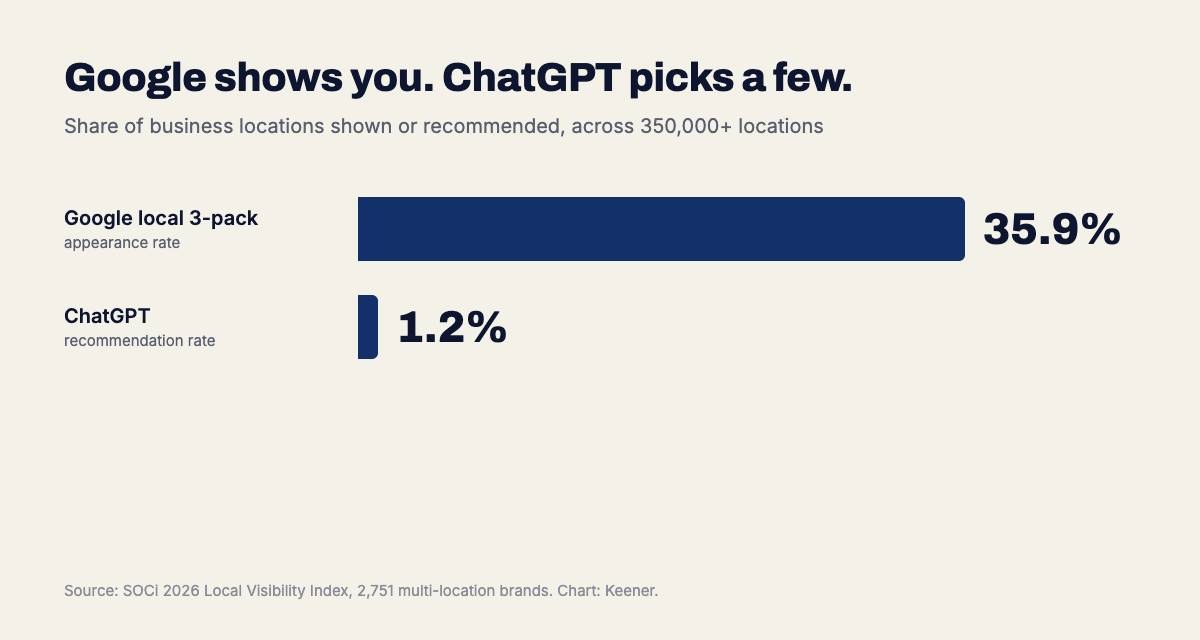
That gap is the real story. In Google, a decent profile with good reviews usually earns you a spot somewhere on the page. In ChatGPT, the field is narrowed to a few names before the customer sees anything. If you are not one of them, you do not exist in that conversation.
The behaviour is also harder to track. A customer who asks ChatGPT for “a good electrician near Gosford” and rings the first name never visits Google at all. Nothing shows up in your Google Business Profile insights, and nothing shows up in your website analytics unless they click through.
Why Google Business Profile is not going anywhere yet
Google Business Profile is not going anywhere because it is still where most people look, and because ChatGPT itself leans on the same kind of information. Killing one does not make sense when the other depends on it.
The search numbers make the point. In keyword data we pulled for Australia in November 2026, “google business profile” averaged tens of thousands of searches a month, and “google my business” around 22,000. Searches for ChatGPT business listings barely registered, because the product is only days old. Owners are still thinking about Google first.
ChatGPT also does not invent its recommendations from nothing. BrightLocal’s research on AI directory sources found Yelp appeared as a source in 80% of ChatGPT’s local answers. Its earlier study of ChatGPT search sources noted the tool was mostly powered by Bing’s index. The details customers see in ChatGPT come from listings, review sites and websites. Many of those are fed by the same information you keep up to date for Google.
So the profile you manage in Google is not wasted effort. It is one of the places the web learns your hours, your address, your category and how happy your customers are.
How does ChatGPT decide which businesses to name?
ChatGPT searches the web when a customer asks, then names businesses it can confirm from several sources. Nobody outside OpenAI knows the exact formula, but early tests point in the same direction.

LinkTech Solutions ran a 20-search study in Southern California in September 2026, asking ChatGPT to recommend tradies, lawyers and other local services. A few findings stood out:
- Directories did most of the work. Of 53 sources ChatGPT cited, 45 were directories or review lists. Only 2 were business websites.
- Location beat review count. 80.7% of listed businesses were in the city that was asked about. In one suburb, the three most-reviewed plumbers ranked 9th, 10th and 12th.
- Reviews helped, but did not decide the order. The top three had a median of 112 reviews against 72 for the rest. The most-reviewed business came first in only 2 of 19 answers.
- The top of the list wins. ChatGPT’s first written pick matched the first business on its list in 18 of 19 answers.

It is a small study from one day in one region, and the author says so. Answers also change between runs. Treat it as a direction, not a rulebook. The direction is clear enough though: ChatGPT rewards businesses that are easy to confirm, close to the customer and well reviewed across more than one site.
What claiming your business does and does not change
Claiming your business gives you control of your information. It does not buy you a better spot, and OpenAI is direct about that: “Claiming does not guarantee higher placement or sales.”
Here is the practical split.
| Claiming does | Claiming does not |
|---|---|
| Add a blue check once your identity is verified | Move you up the list of recommendations |
| Let you correct your description, hours, policies and photos | Let you pay your way into answers |
| Let retailers share prices and stock through a product feed | Show you competitors or individual conversations |
| Show mentions, website clicks and discovery topics | Explain why a number went up or down |
The insights are useful, with caveats. Hans van Gent’s breakdown of the Business Hub numbers notes that for a local business, a mention counts when ChatGPT shows a result for your location, even if nobody clicks. A blank figure can mean activity below a reporting threshold, not zero. And you cannot see the prompts people typed. His advice is to keep your own record of what ChatGPT says to your customers’ questions, and we agree.

What should an Australian business do this month?
Treat ChatGPT as a second shopfront window that needs the same care as your Google profile. Here is the order we would work in.

- Keep your Google Business Profile spotless. Correct categories, hours, service areas, photos, and replies to every review. It still sends most of your local enquiries.
- Check whether you can claim in ChatGPT. If you run an online business with a website, you may be able to claim through Business Hub now. If you run a local shopfront, note that claiming for local listings started in the US, and be ready when it widens.
- Make your details agree everywhere. Name, address, phone, hours and categories should match across Google, Bing Places, Apple Business Connect, Yelp, Foursquare and the directories in your industry. ChatGPT trusts what it can confirm.
- Keep reviews coming on more than one site. A steady stream beats a burst, and reviews on directories ChatGPT cites count as well as Google ones.
- Make your website easy to quote. One clear page per service, your suburbs named in plain words, prices or price ranges where you can, and FAQs that answer what customers actually ask. If you need a starting point, our guide to getting your website on Google covers the basics that help here too.
- Start your own baseline. Write down ten questions your customers ask, ask ChatGPT each one, and record who it names. Repeat it every month. It is free and it shows you more than any dashboard.
Most of the local businesses we look after already have most of this in place for Google. The gap is usually the second tier of listings, such as Bing Places and industry directories, which nobody has touched in years. That is where details drift, and drifting details are exactly what makes ChatGPT unsure about a business.
So, is this the end of Google My Business?
No. It is the end of Google being the only listing that matters. For twenty years, local visibility meant one profile and one map. Now there is a second front door, it opens onto a much shorter list, and the businesses on that list are the ones the whole web agrees on.
The owners who do well from this will not be the ones who rush to claim a profile and stop there. They will be the ones whose details, reviews and website are consistent enough that ChatGPT can recommend them with confidence, whether they have claimed or not.
Frequently asked questions
Can I claim my business in ChatGPT from Australia?
Possibly. Claiming opened in beta on 10 November 2026 for eligible businesses with a website, in places where ChatGPT and verification are supported. At launch, local shops and restaurants could only claim existing US listings, so Australian online businesses have the clearest path right now.
Does claiming my business improve my ChatGPT ranking?
No. OpenAI states that claiming does not guarantee higher placement or sales. It gives you control over your details and access to insights. Recommendations still depend on what ChatGPT finds about you across the web.
Is Google My Business the same as Google Business Profile?
Yes. Google renamed Google My Business to Google Business Profile in 2021. Most people still search for the old name, and it is the same free listing that appears in Google Search and Maps.
What is a ChatGPT Business Agent?
A Business Agent is an assistant inside ChatGPT that answers customer questions using your product and policy information, within guidelines you set. At launch it is limited to eligible US ecommerce and online service businesses.
Get your business ready for ChatGPT
If you would like this handled for you, we claim and set up ChatGPT business profiles, then keep the listings, reviews and content it checks in shape each month, alongside your SEO. If your website is part of the problem, see how we approach website design.